



How Kitchener Boosted their Official Plan with Climate and Energy Insights

Rigorous research and policy analysis helped embed climate action into Kitchener’s long-term plan


21 May 2026
Kitchener is growing fast. SSG’s analysis helped the City understand how their Official Plan can shape that growth so that future generations can enjoy an affordable and climate resilient Kitchener.
Kitchener is on track to grow by 150,000 people by 2051, inevitably impacting how the city functions. City leadership can shape impacts with decisions it makes today, like where homes get built, how streets are designed, where energy comes from, and what kinds of buildings get permitted.
These decisions are embedded in Kitchener’s new Official Plan (OP), Kitchener 2051. They will determine whether residents end up with a city that’s walk (and bike!)-able, affordable, and resilient to a changing climate, or one locked into high energy use and costly infrastructure for future generation. SSG worked with the City to understand the implications of Official Plan policies in shaping Kitchener’s future.
City leadership can shape impacts (of growth) with decisions it makes today.
Building the Evidence Base
SSG used three guiding questions to conduct a Climate and Energy Technical Background Study:
1. How does Kitchener need to change the way it grows to reduce greenhouse gas (GHG) emissions by at least 80% by 2051?
2. What policies does the Official Plan need to support the clean energy transition?
3. How does Kitchener need to change to reduce climate risks to the health of its community and infrastructure?
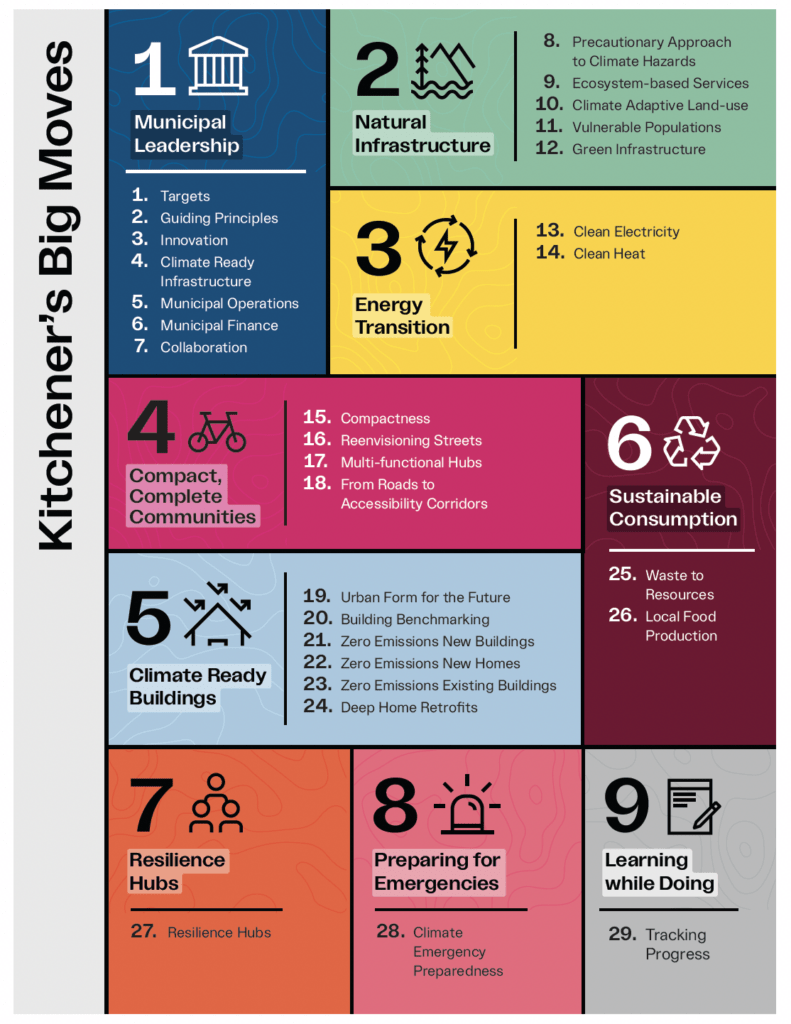
SSG synthesized findings from scientific literature and best practices from jurisdictions across Ontario and beyond. The Study provided a climate and energy framework organized around nine “Big Moves.” The framework gave Kitchener’s planning team specific, evidence-backed directions to weave throughout the OP.
1. How does Kitchener need to change the way it grows to reduce greenhouse gas (GHG) emissions by at least 80% by 2051?
2. What policies does the Official Plan need to support the clean energy transition?
3. How does Kitchener need to change to reduce climate risks to the health of its community and infrastructure?
Putting It to the Test
SSG also modelled three different approaches to accommodating population growth: 1) concentrating development in nodes and corridors, 2) building new urban centres, and 3) distributing growth throughout existing neighbourhoods.
Modelling outputs supported our research findings: Denser, transit-oriented growth reduces vehicle kilometres travelled, lowers household energy costs, and makes district energy systems viable. This results in lower emissions, lower energy costs, less time spent commuting, better air quality, greater in-home temperature comfort, and more resilience to climate impacts.
Dispersed growth locks in high-carbon land uses and transportation behaviours for several generations. This would leave Kitchener vulnerable to damaging and expensive climate impacts, with residents stuck in homes that struggle to stay comfortable through extreme heat or cold, and missed home renewable energy income and energy efficiency savings.
Denser, transit-oriented growth reduces vehicle kilometres travelled, lowers household energy costs, and makes district energy systems viable.
Missing a climate connection in an OP can accidentally … exacerbate unaffordability (and) poor health for decades.
Reviewing the Draft Plan
Once drafted, SSG reviewed the full OP prepared by Kitchener’s planning team, refining policies through the lens of climate action and energy transition. SSG created a scorecard to identify how well Kitchener’s OP integrated climate and energy transition considerations across eleven categories including strategic alignment, finance & resourcing, and best practices. The scorecard helped highlight the areas where the Plan showed commitment and leadership in addressing climate implications, while also highlighting where the plan could improve.
We think other municipalities can benefit from this type of scan of their OP. Missing a climate connection in an OP can mean accidentally locking in emissions, car-dependent growth patterns, or development behaviours that exacerbate unaffordability and poor health for decades. Having a team review an OP specifically through a climate and energy lens helps cities catch those issues before the plan is finalized, and before the concrete gets poured.
About the Author

Nada (she/her) is driven by her passion for equitable and sustainable urban development. She plays many roles at SSG, from leading multidisciplinary teams on projects related to climate change to designing and implementing engagement strategies throughout the project lifecycle. Nada draws from her background in international development, urban design, and urban planning, where she has focused on the co-creation of development plans with communities in numerous countries.

Jeremy (he/him) is an urban planner and climate change planner focused on fostering community climate emergency solutions. A foremost expert on climate change mitigation planning, he has led teams in developing leading climate action plans for all levels of government as well as institutions across North America. Jeremy is experienced with community energy and emissions modelling, climate change mitigation and adaptation planning, policy development, green building systems and policies, integrated design facilitation, and public engagement.
Contact Us
We can help you address the climate crisis and navigate the energy transition