


Washington State: Comprehensive Plans prevent emissions and costs lock-in!

Could a climate lens empower your next comprehensive plan with better outcomes for residents?
20 August 2026
Under Washington’s Growth Management Act, some jurisdictions must plan for climate change and many others can choose to. The evidence shows that either way, a climate lens leads to better outcomes for residents.
Can a zoning decision influence how a community is impacted by a flood or heat wave? Absolutely. A comprehensive plan is one of local government’s most powerful tools for dealing with climate change impacts. It sets a city or county’s emissions, its exposure to climate hazards, and its residents’ utility and insurance bills for decades, whether or not it consciously sets out to.
weaving climate into (comprehensive) plans makes low-carbon outcomes easier to achieve than almost any other municipal mechanism
Under the Growth Management Act, Washington’s largest counties and cities are required to add a climate element to their comprehensive plans, while all other jurisdictions are encouraged to opt in. That work can be funded through climate planning grants administered by the Washington State Department of Commerce.
Across more than 450 projects over the past two decades, SSG’s analysis has shown that adding a climate lens to the planning process is crucial to producing better outcomes for residents. .
Comprehensive plans set where and how a community grows, and that shapes its transportation, buildings, energy systems, and the emissions they generate. As SSG Principal Consultant Jeremy Murphy writes, weaving climate into these plans makes low-carbon outcomes easier to achieve than almost any other municipal mechanism. The reason is timing. The travel patterns and energy use built into a neighborhood endure for decades, and they are costly to change once the ground is broken.
Planning decisions lock in costs for decades
Every development pattern commits a community to decades of expenses. Low-density, car-dependent growth requires roads, pipes, and utilities that have to be built and maintained. Although development of these municipal services is often covered by developers (and passed on to home buyers), municipalities typically cover operation and maintenance costs in perpetuity. These costs are often 5 to 10 times more expensive than maintaining the infrastructure of dense neighbourhoods of similar populations. These are funds that could be used to improve the lives of residents instead.
The financial risk of ignoring climate hazards is just as concrete. In Airway Heights, Washington, the Climate Risk and Vulnerability Assessment SSG prepared found that a worst-case wildfire could damage more than 2,500 buildings and cause more than $550 million in residential and $1.1 billion in commercial damages. Our assessment identified that structural and vegetation measures taken by the municipality could avoid up to 75% of those costs. These findings are included in Airway Heights’ recent Comprehensive Plan update draft, ensuring they will be addressed as a part of standard planning processes.
$1.6B
in residential and commercial damages in a worst-case wildfire in Airway Heights, WA
75%
damages avoided with structural and vegetation measures identified in assessment.
Understanding which areas carry this profile of elevated risk and higher numbers of vulnerable residents gives cities a crucial way to prioritize where to direct adaptive actions.
The effects of climate impacts are not shared equally
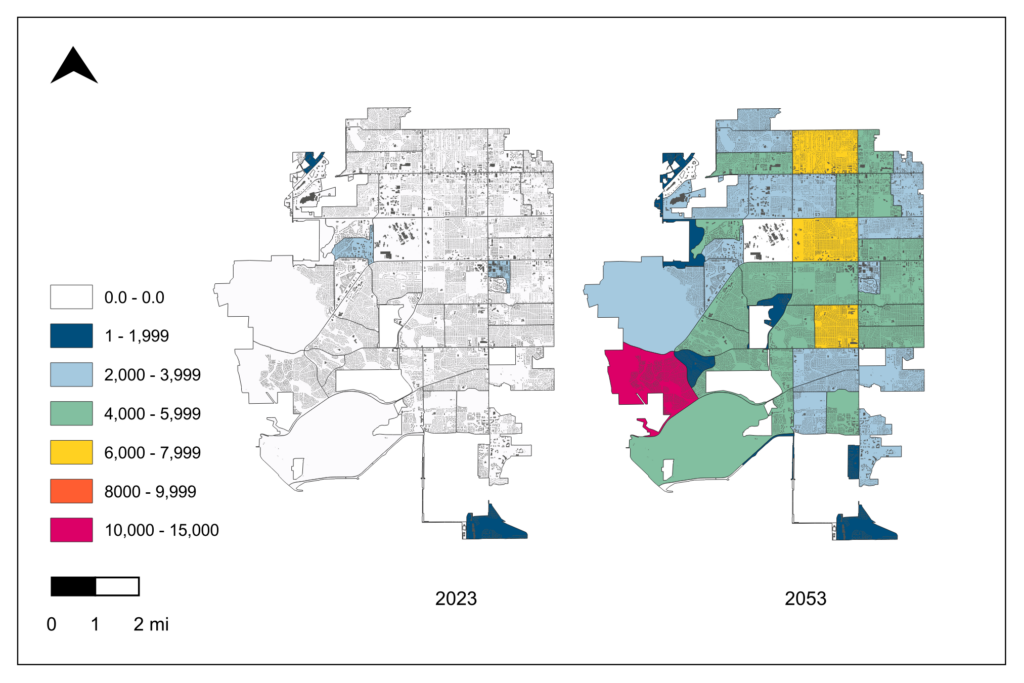
The burden of climate impacts are not distributed evenly across a community. For the City of Lakewood, Colorado, SSG paired a spatial equity index with local infrastructure and climate impact projections to identify which residents will struggle most to recover.
For example, in the case of extreme heat events, some neighbourhoods have a higher likelihood of experiencing elevated overnight temperatures while also having a high number of residents who are more vulnerable to heat-related health risks. Knowing this allows the city to prioritize where to direct adaptive actions such as cooling infrastructure or building retrofit programs.
A climate lens is also an affordability lens
Buildings that are efficient and electrified cost less to run, which matters in a place like Airway Heights, whose older buildings are expensive to heat and cool. neighbourhoods designed so people can reach daily destinations on foot, by bike, or by transit reduce the need to own and fuel a car, one of the largest fixed costs a household carries, while compact growth spares local governments the expense of extending far-flung infrastructure. When SSG modeled how different building standards would affect emissions in the City of Courtenay through 2050, the analysis gave the city the evidence it needed to require net-zero emissions for new buildings in its community plan.
Comprehensive plans shape energy security
Comprehensive plans also shape a community’s energy future. Plans that make room for renewable energy and efficiency help protect residents against volatile fossil fuel prices and avoid locking in gas infrastructure that can later become a stranded cost. When SSG modeled Washington state’s energy decarbonization pathways for the Washington Utilities and Transportation Commission, viable pathways delivered more than $28 billion in net societal benefits compared with the status quo. The analysis showed that local renewable energy plays an important role in realizing these benefits, and it is something local jurisdictions can encourage and plan for.
The case for the climate lens
For many Washington jurisdictions, adding a climate element is a choice rather than an obligation. The evidence from these projects points in one direction: it is the choice that leaves residents safer, spends public money more wisely, and creates a comprehensive plan that is meant to last. With Commerce grants available to fund the work, the case is strong for integrating a climate lens into comprehensive plans.
Plans that make room for renewable energy and efficiency help protect residents against volatile fossil fuel prices.
Related Insights
Contact Us
We can help you address the climate crisis and navigate the energy transition